
Buyer’s Guide · Guide #7 of 10
Is Costa Rica Real Estate a Good Investment?
Honest analysis of Costa Rica real estate as an investment: historical appreciation, vacation rental yields, tax implications, community fundamentals, and the real risks foreign buyers should understand.

A Note from Melanie
I’ve been selling luxury real estate on Costa Rica’s Guanacaste Gold Coast for a decade. I’ve watched hundreds of foreign buyers navigate this market — some smoothly, some not. The questions in this guide are the ones I answer on almost every first call. My goal here is to give you exactly what I’d tell a close friend who called asking about buying in Costa Rica. No fluff. Just what you need to know.
Key Takeaways
- Costa Rica has delivered consistent appreciation across multiple cycles — the Guanacaste Gold Coast has outperformed many comparable Latin American markets over the past decade.
- Vacation rental income is real but projections from sellers and developers are often optimistic — model conservatively and verify with independent property management data.
- The strongest investment fundamentals are in communities with limited supply, strong international demand, and proven resale liquidity.
- Foreign buyers pay no extra capital gains tax in Costa Rica beyond the 15% domestic CGT introduced in 2019 — there is no additional tax burden for non-residents on property sales.
- All transactions are in US dollars which eliminates currency risk for US buyers and simplifies investment modeling.
- The best investment in Guanacaste is a property you would want to own even if it never generated a dollar of rental income — that discipline protects you from overpaying on yield projections.
Question 01
Has Costa Rica real estate historically been a good investment?
Direct Answer
Yes, across most of the Guanacaste Gold Coast and over most holding periods greater than five years, real estate has delivered meaningful appreciation. The market is driven by sustained international demand, limited developable beachfront inventory, and growing infrastructure investment. It has also shown resilience through global disruptions, including a faster-than-average post-COVID recovery in 2021–2023.
Key factors that have supported appreciation on the Gold Coast:
- Supply constraints: Guanacaste’s coastline is finite. The combination of the Maritime Zone Law (restricting beachfront development), SETENA environmental permitting, and established community build-out limits the supply of new inventory in the most desirable locations.
- Infrastructure investment: the Guanacaste International Airport (LIR) has expanded direct international routes significantly over the past decade, reducing travel friction for North American and European buyers and increasing the pool of potential purchasers and renters.
- Sustained international demand: post-pandemic, Costa Rica benefited from a significant increase in both remote workers and lifestyle-driven relocation. This demand has been sticky — many who came for a year stayed permanently or became frequent visitors who subsequently bought.
- USD-denominated market: pricing in US dollars protects both sellers and buyers from local currency volatility and makes the investment more comparable to other USD-denominated assets.
What the market has not been: a speculative flipping market. Properties purchased at fair market value for short holding periods have not consistently outperformed. The Guanacaste luxury market rewards patient, informed buyers — not traders.
Question 02
What kind of rental income can I realistically expect?
Direct Answer
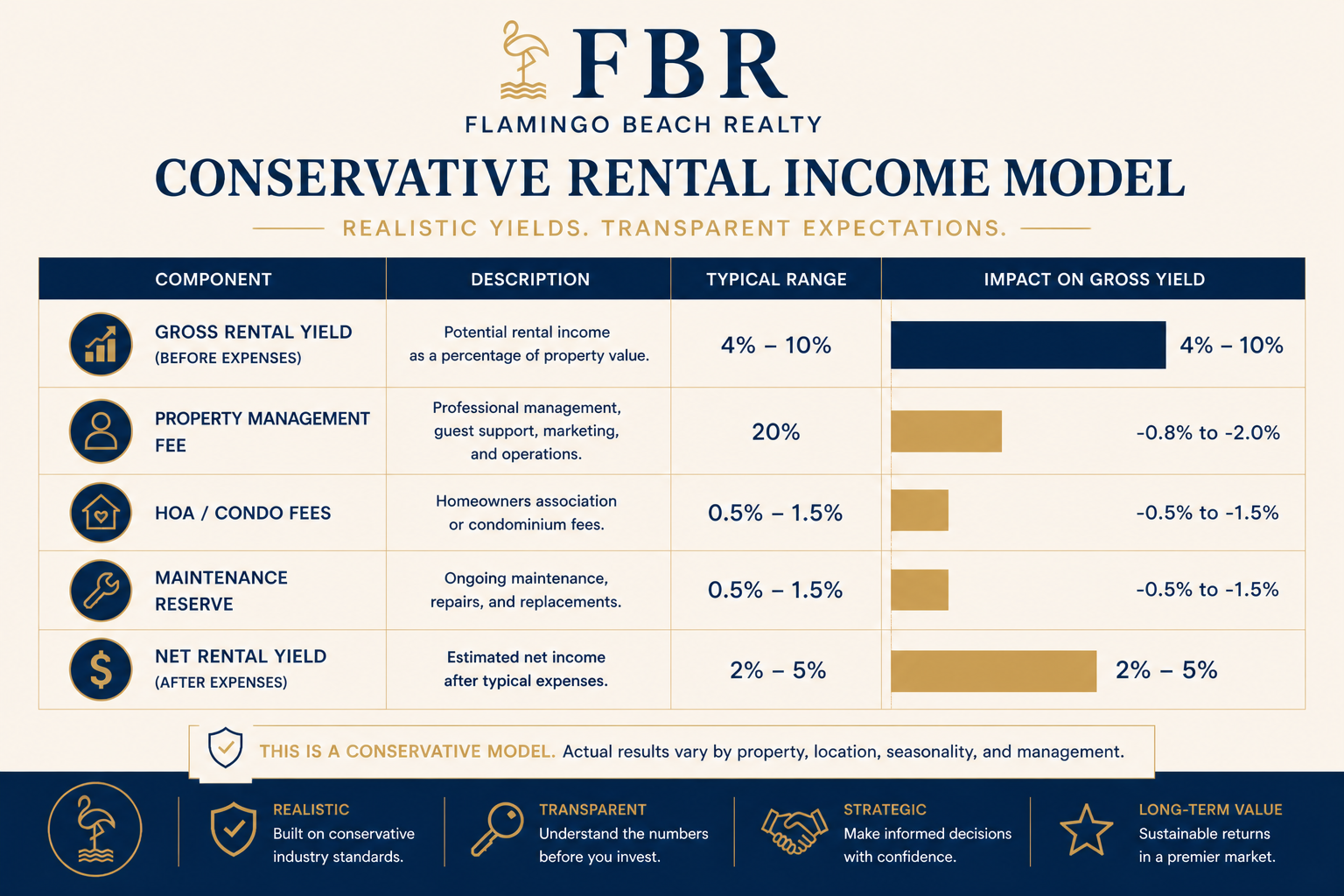
Gross vacation rental yields in Guanacaste’s top communities typically range from 4–10% of property value annually, before expenses. Net yield after property management (20%), HOA, property tax, maintenance, and platform fees is typically 2–5%. Projections from sellers and developers frequently use occupancy rates and nightly rates at the optimistic end — always model from conservative assumptions and verify with independent property managers.
Factors that most influence rental performance:
- Community and location within the community: a front-row Hacienda Pinilla beachfront villa performs differently from a property set back from the beach. Ocean view, pool access, and walkability to amenities drive a premium.
- Property management quality: the difference between a well-managed vacation rental and a poorly managed one is not marginal — it is often 30–50% in net revenue. Choose your property manager wisely.
- Seasonality: Guanacaste’s peak rental season runs December through April (dry season). Shoulder and low season occupancy varies significantly by community. Budget conservatively for the 3–4 months of low season.
- Listing platform presence: properties listed only on one platform typically underperform compared to those actively managed across Airbnb, VRBO, luxury rental networks, and direct booking channels.
A practical note on peak season: the three rental weeks that define Guanacaste’s income calendar are Christmas, New Year’s, and Easter (Semana Santa). Well-positioned, well-managed properties consistently generate enough revenue during those three periods alone to cover their full annual carrying costs. Beyond rental income, the Gold Coast has delivered exceptional appreciation over the past decade — buyers who purchased quality properties in established communities have seen substantial gains that dwarf the annual yield.
How to Model Rental Income
Start with a conservative occupancy assumption: 50–60% annualized is realistic for a well-managed property in a strong community. Apply a conservative average nightly rate based on comparable active listings (not projected rates). Deduct 20% property management fee, HOA, property tax, utilities, maintenance reserve (budget 1–2% of property value annually), and platform fees. The result is your net yield — if it is positive and acceptable to you, the rental income is a bonus. If the investment only works with optimistic projections, it is not the right investment.
Question 03
Which communities offer the strongest investment fundamentals?
Direct Answer
Playa Flamingo, Reserva Conchal, and Peninsula Papagayo offer the strongest combination of resale liquidity, rental demand, and supply constraint. Playa Tamarindo leads Guanacaste in short-term rental volume. Las Catalinas is strong within its specific buyer niche. Hacienda Pinilla offers very good value and a larger resale market. Within any community, beachfront and ocean-view properties consistently outperform inland positions over time.
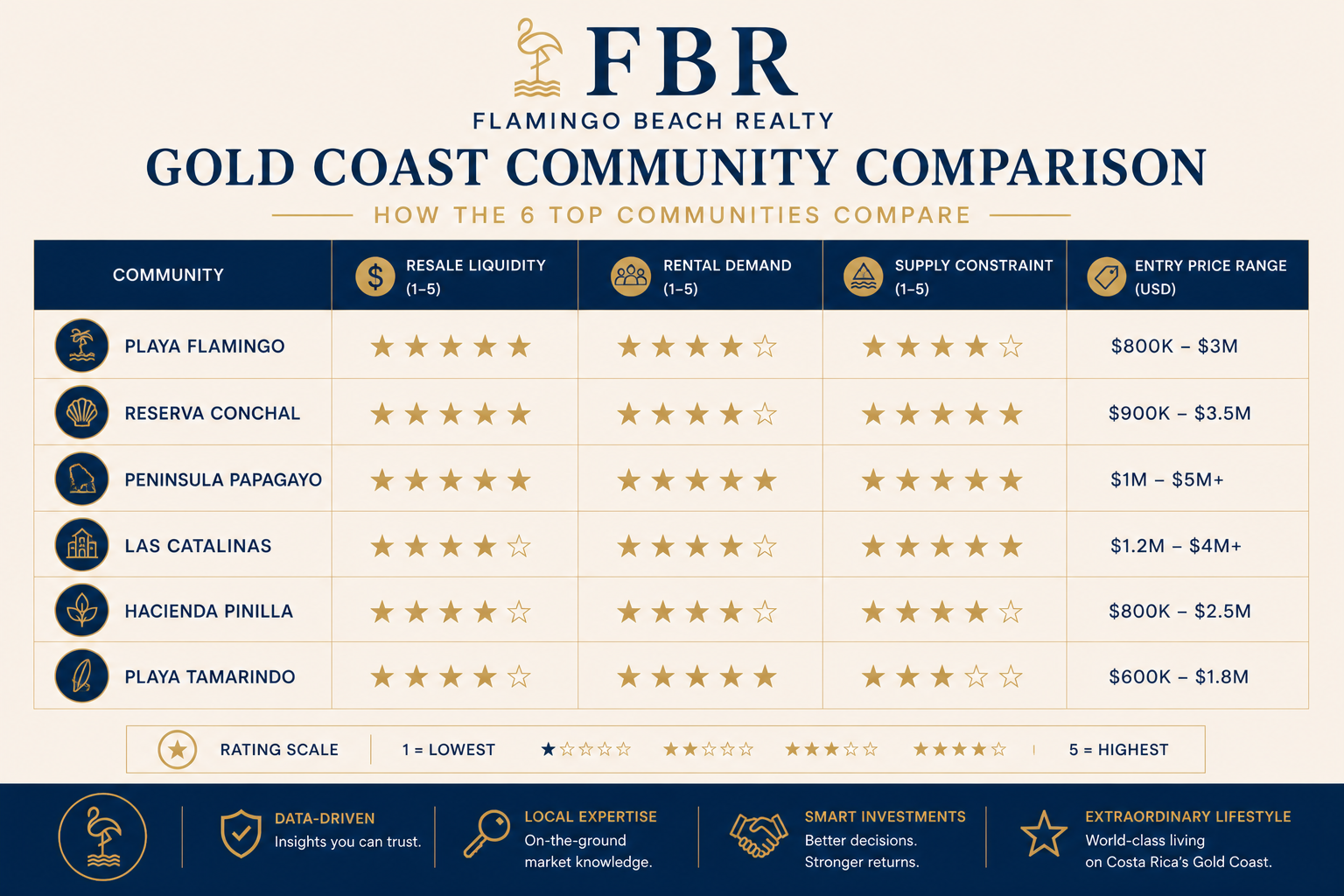
Playa Flamingo: strong resale liquidity, established buyer pool, marina access, and one of the best beaches on the Pacific coast. FBR’s home market and our most consistently active transaction community.
Reserva Conchal: resort-level amenities — golf, tennis, hiking, multiple pools, gym, restaurants, and bars — keep owners and short-term renters returning year after year. Master-planned supply control limits future competition. Higher HOA costs are offset by consistent rental demand from guests seeking a full-resort experience.
Peninsula Papagayo: highest price per square foot and highest rental rate ceiling. Suitable for buyers targeting the ultra-luxury segment. Less price sensitivity to broader market corrections due to brand association and very limited supply.
Las Catalinas: niche but deep demand from a specific and loyal buyer type. Resale pool is smaller but highly committed. Appreciation has been strong within the community since it opened.
Playa Tamarindo: the highest short-term rental volume in Guanacaste per AirDNA, with 3,600+ active listings, median occupancy near 50%, and a median ADR around $389/night. Strong international brand recognition, a walkable town center, and the widest range of price points on the Gold Coast make it one of the most accessible entry points for investment buyers.
Hacienda Pinilla: Good value relative to comparable communities. Wonderful amenities with a larger resale market than Flamingo or Conchal. Best for buyers who prioritize the lifestyle over maximum liquidity.
Question 04
What are the tax implications of owning and selling investment property in Costa Rica?
Direct Answer
Costa Rica introduced a capital gains tax (CGT) of 15% of net gain in 2019, applicable to properties whose primary purpose is investment. Annual property tax is 0.25% of declared value. The Luxury Solidarity Tax applies to properties with construction value above approximately $300,000. Foreign buyers are also subject to their home country’s tax rules on foreign property income and gains — typically US or Canadian reporting requirements.
Capital gains tax (Costa Rica): 15% of net taxable gain on properties sold after July 1, 2019. Properties registered before that date may be subject to transitional provisions. Your attorney and tax advisor should review the specific property’s registration date and tax history at the time of purchase.
Buyer’s CGT withholding obligation: when purchasing from a non-domiciled seller (including most foreign-owned corporations), the buyer is legally required to withhold 2.5% of the sale price and remit it to Hacienda. This is handled by your attorney at closing and does not add to your net cost — it is credited against the seller’s tax liability — but you must ensure it is properly handled or you risk joint liability.
Rental income tax (Costa Rica): rental income earned in Costa Rica is subject to Costa Rican income tax. The applicable rate and structure depends on whether you are operating as an individual or through a corporation, and the nature of the rental activity. A local accountant should advise on proper registration and filing.
US tax reporting: US citizens and residents must report foreign rental income and foreign property ownership on their US tax returns. The Foreign Tax Credit may offset some Costa Rican taxes paid. FBAR (FinCEN 114) filing is required if your foreign financial accounts exceed $10,000. FATCA reporting may also apply.
Canadian tax reporting: similar foreign property income and gain reporting requirements apply to Canadian residents under CRA rules. The T1135 Foreign Income Verification Statement is required for foreign property with a cost basis above CAD $100,000.
Tax planning for a Costa Rican property purchase is not complex but does require attention. A cross-border tax advisor who works with both Costa Rican and home-country obligations is worth engaging before closing — not after the first rental income arrives.
Question 05
What are the risks of investing in Costa Rica real estate?
Direct Answer
The primary risks are title and legal risk (mitigated by thorough due diligence), over-reliance on rental income projections, illiquidity relative to financial assets, and political or regulatory risk. None of these are reasons to avoid the market — they are reasons to approach it with professional guidance and realistic expectations.
Title and legal risk: the single most controllable risk. A thorough attorney-led due diligence process eliminates the vast majority of title risk. Buyers who skip or abbreviate due diligence bear this risk voluntarily.
Rental income risk: vacation rental income is real but variable. Occupancy rates and nightly rates are cyclical, seasonal, and platform-dependent. Never purchase a property whose economics depend on optimistic rental projections.
Liquidity risk: Costa Rican real estate is illiquid relative to financial assets. In a down market, properties can take 12–24+ months to sell at fair value. Build your overall portfolio with this in mind.
Property management risk: the quality of local property management directly affects both rental income and property condition. Vet your property manager before you buy. The market has reputable operators and unreliable ones.
Regulatory and political risk: Costa Rica has a stable democratic government and a strong rule of law by regional standards. However, regulatory changes affecting rental platforms, environmental permitting, or Maritime Zone policy can affect property values. This risk is low but not zero.
The investors who have done well in Guanacaste over the past decade share common traits: they bought properties they would want to own regardless of rental income, they engaged qualified local professionals for legal and management services, they held for meaningful periods, and they were not dependent on the investment performing to a specific yield target. Those who have done poorly typically did the opposite of one or more of these things.
About Flamingo Beach Realty
Flamingo Beach Realty is the #1 luxury real estate brokerage on Costa Rica’s Guanacaste Gold Coast, with 500+ five-star reviews and $900M+ in closed transactions. We serve buyers and sellers across Playa Flamingo, Reserva Conchal, Hacienda Pinilla, Las Catalinas, Peninsula Papagayo, and the surrounding Guanacaste communities.