
Buyer’s Guide · Guide #2 of 10
Closing Costs in Costa Rica: What Every Foreign Buyer Needs to Budget
A complete breakdown of buyer closing costs (3.5–5%), what sellers pay, ongoing annual taxes, the Luxury Solidarity Tax, and the costs that catch buyers off guard — for Guanacaste luxury transactions in US dollars.
A Note from Melanie
I’ve been selling luxury real estate on Costa Rica’s Guanacaste Gold Coast for a decade. I’ve watched hundreds of foreign buyers navigate this market — some smoothly, some not. The questions in this guide are the ones I answer on almost every first call. My goal here is to give you exactly what I’d tell a close friend who called asking about buying in Costa Rica. No fluff. Just what you need to know.
Key Takeaways
- Budget 3.5–5% of the purchase price in closing costs — on top of the property price.
- Transfer tax is 1.5% of the registered transfer value, paid by the buyer.
- Attorney fees run 1.25–1.5%, regulated by the Costa Rican Bar Association.
- All luxury real estate in Guanacaste is transacted in US dollars.
- Annual property tax is just 0.25% of declared value — one of the lowest rates in Latin America.
- The 10% PSA deposit is due immediately when an offer is accepted, held in escrow and credited at closing.
Question 01
What does a buyer pay at closing in Costa Rica?
Direct Answer
Buyer closing costs in Costa Rica typically total 3.5–5% of the purchase price. The buyer pays: transfer tax (1.5%), registry and documentary fees (~0.80%), attorney fees (1.25–1.5%), and escrow fee. All of this is in addition to the purchase price — budget for it separately.
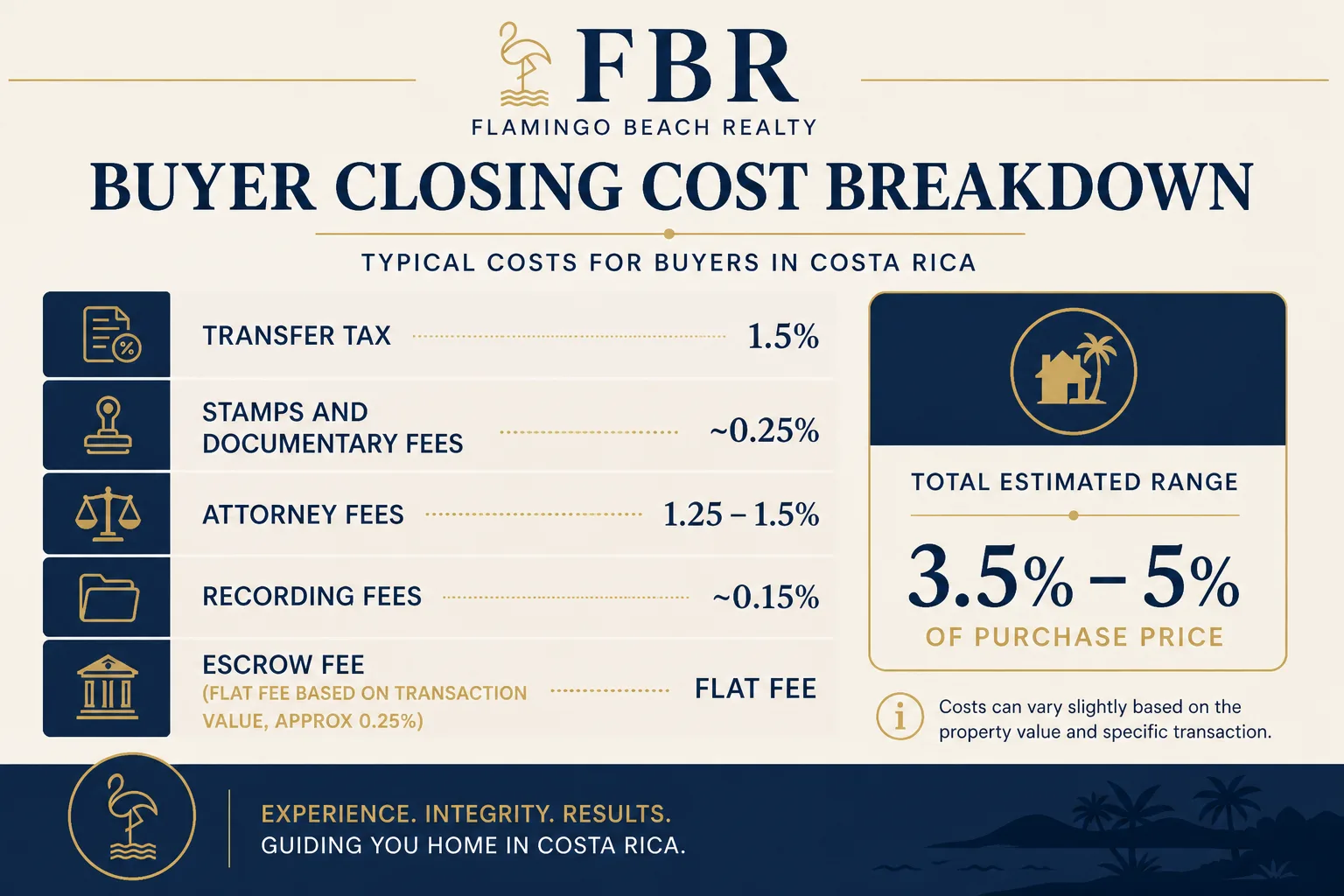
Here is how each cost breaks down:
- Transfer tax (Impuesto de Traspaso): 1.5% of the registered transfer value. This is a government tax paid to the National Registry on every property sale.
- Registry and documentary fees: approximately 0.80% of the purchase price per quatro.legal. Covers National Archive stamps, Bar Association stamps, court stamps, and National Registry recording fees — all mandatory government fees paid at closing.
- Attorney fees: 1.25–1.5% of the purchase price, regulated by the Costa Rican Bar Association. The minimum is not negotiable below the regulated schedule. Attorneys who quote significantly below this are worth scrutinizing.
- Escrow fee: varies by company. Stewart Title and TLA typically charge $1,500–$3,500 flat or a small percentage of the transaction value.
Note on the deposit: the 10% good-faith deposit submitted with your Purchase & Sale Agreement (PSA) is not a closing cost. It is held in escrow and credited in full toward the purchase price at closing. You need those funds available quickly — typically within 3–5 business days of an accepted offer.
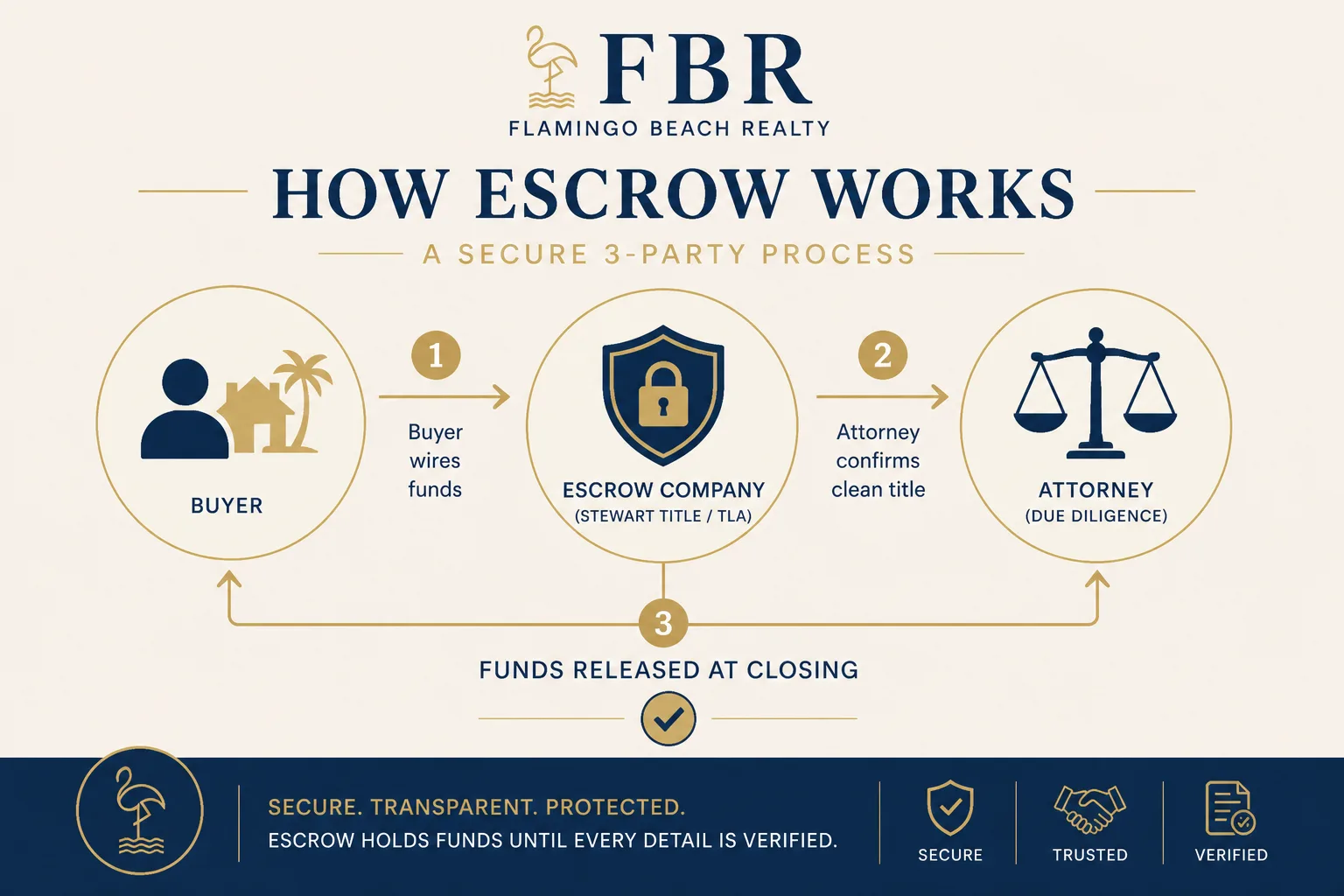
How does escrow work?
Funds are held by an established escrow company (Stewart Title, TLA, or reputable local alternatives) rather than by your attorney or agent. Never wire funds directly to a seller or agent. Escrow protects both parties until your attorney confirms clean title — funds are released at closing.
Question 02
What does the seller pay at closing?
Direct Answer
The seller pays the real estate agent commission (6% of the sale price), any outstanding property tax and HOA balances, and capital gains tax where applicable. In standard Guanacaste transactions, the buyer pays transfer tax and their own attorney — the seller pays commission and brings any balances current.
- Agent commission: 6% of the sale price, paid by the seller. This is the standard across Guanacaste and is not negotiable with full-service brokerages.
- Outstanding property tax: any unpaid Impuesto Sobre Bienes Inmuebles must be cleared before the transfer deed can be executed.
- HOA dues in arrears: if the seller owes unpaid HOA dues, these are typically settled at closing. Your attorney’s due diligence will surface any outstanding balances.
- Capital gains tax (Impuesto a las Ganancias de Capital): 15% of the net gain on properties sold after July 1, 2019. Properties registered before that date may be subject to transitional provisions — your attorney will advise based on the specific property and registration date.
- Seller’s own attorney: if the seller retains independent legal counsel (not required but common in complex transactions).
Question 03
What are the ongoing annual costs after closing?
Direct Answer
After closing, your primary recurring costs are property tax (0.25% of declared value annually), the Luxury Solidarity Tax if applicable, HOA fees, and property management if you’re renting. Costa Rica’s property tax rate is one of the lowest in Latin America — ongoing costs are generally manageable relative to purchase price.
- Property tax (Impuesto Sobre Bienes Inmuebles): 0.25% of the municipally declared property value, paid quarterly to the local municipality (cantón). This is based on the declared value — not necessarily the market value — and is generally quite low relative to US or Canadian property tax rates.
- Luxury Solidarity Tax (Impuesto Solidario): an additional annual tax on properties with a construction value above approximately $300,000. Graduated rate of 0.25–0.55% applied to the construction value, not the total property or land value. See Question 4 for a full breakdown.
- HOA / maintenance fees: vary significantly by community. Reserva Conchal: $200–$1,500+/month depending on property type and services. Smaller or less-amenitized communities: $150–$300/month. Always request the current HOA budget, reserve fund status, and any pending special assessments before closing.
- Property management: if using the property as a vacation rental or maintaining it while absent, budget 20% of rental revenue plus a small flat monthly fee. This covers guest management, coordination, and property oversight.
- Utilities: water, electricity, and internet costs vary by community and usage. Request 12 months of utility bills from the seller during due diligence to establish a realistic baseline.
- Insurance: homeowner’s insurance is not legally required in Costa Rica but is strongly recommended for any property with a mortgage or significant value. Rates vary but are generally lower than comparable US coastal properties.
Question 04
How does the Luxury Solidarity Tax work?
Direct Answer
The Impuesto Solidario is an annual tax that applies to properties with a construction value above approximately $300,000. The rate is graduated from 0.25% to 0.55% and applies to the construction value only — not the land, not the total property value. This distinction matters significantly for budgeting.
The tax was introduced as a social equity measure; proceeds fund Costa Rica’s affordable housing programs. The rate schedule is:
- 0.25% on construction value between approximately $300,000 and $700,000
- 0.30% on construction value between $700,000 and $1,000,000
- 0.35% on construction value between $1,000,000 and $2,000,000
- Higher brackets apply at increasing rates above $2,000,000
As a practical example: a luxury villa with a construction value declared at $600,000 would pay approximately 0.25–0.30% on that amount — roughly $1,500–$1,800 per year. The assessment is based on municipally declared construction values, which in many cases are below current replacement cost. Your attorney should verify the current Impuesto Solidario assessment as part of due diligence, and flag any significant discrepancy between the declared value and the actual construction cost.
Note: the calculation is applied to the construction value registered with the municipality, not the sale price. Two identical homes can have very different Impuesto Solidario obligations depending on what values were declared historically. This is worth understanding before you close.
Question 05
What costs do foreign buyers in Costa Rica commonly miss?
Direct Answer
The costs that catch buyers off guard are almost never the standard closing costs — those are predictable and disclosed early. The surprises are typically the PSA deposit timing, import duties on furnishings, property management setup, and community-specific fees that aren’t always disclosed upfront.
Here is what experienced buyers wish they had budgeted for from the start:
- PSA deposit timing: the 10% good-faith deposit is due within 3–5 business days of an accepted offer — not at closing. Many buyers plan for closing costs but have not pre-staged the deposit funds for wire. Make sure 10% is liquid and accessible before you make an offer.
- Furniture and import duties: most luxury homes in Guanacaste are sold unfurnished or partially furnished. Importing quality furniture from the US or Canada into Costa Rica carries customs duties that can add 15–25% to the replacement cost of the goods. Budget this as part of your total acquisition cost, not an afterthought.
- Property management setup: if you plan to offer the home as a vacation rental, initial professional photography, platform setup, and listing fees can run $2,000–$5,000. This is in addition to the ongoing management fee.
- Utility connection and transfer fees: some municipalities charge administrative fees to transfer electricity and water accounts. Minor in absolute terms but worth knowing.
- HOA move-in or capital assessment fees: some communities charge a one-time move-in fee or capital contribution on ownership transfer, separate from monthly dues. This is community-specific. Always ask explicitly — it is not always disclosed unless you ask.
- Legal and corporate maintenance: if you are taking title through a Costa Rican corporation (common for asset protection and estate planning), there are annual legal fees to maintain the corporation in good standing, typically $300–$600/year.
About Flamingo Beach Realty
Flamingo Beach Realty is the #1 luxury real estate brokerage on Costa Rica’s Guanacaste Gold Coast, with 500+ five-star reviews and $900M+ in closed transactions. We serve buyers and sellers across Playa Flamingo, Reserva Conchal, Hacienda Pinilla, Las Catalinas, Peninsula Papagayo, and the surrounding Guanacaste communities.
Ready to budget your Costa Rica purchase?
Talk directly with Melanie Engel, principal broker and founder of Flamingo Beach Realty — 500+ five-star reviews, $900M+ in closed transactions across Guanacaste’s Gold Coast.