
Buyer’s Guide · Guide #6 of 10
Due Diligence in Costa Rica: What to Verify Before You Buy
Title insurance does not exist in Costa Rica — your independent attorney’s title search is your only protection. Here is exactly what due diligence covers, how long it takes, and the red flags that should stop a transaction.

A Note from Melanie
I’ve been selling luxury real estate on Costa Rica’s Guanacaste Gold Coast for a decade. I’ve watched hundreds of foreign buyers navigate this market — some smoothly, some not. The questions in this guide are the ones I answer on almost every first call. My goal here is to give you exactly what I’d tell a close friend who called asking about buying in Costa Rica. No fluff. Just what you need to know.
Key Takeaways
- Due diligence in Costa Rica is attorney-led, not lender-led — title insurance does not exist in Costa Rica, so your attorney is your primary and only protection.
- A title search back 30+ years is standard practice and must be conducted by your independent Costa Rican attorney.
- The due diligence period is typically 10–30 days, with the average being 21 calendar days from acceptance.
- Survey verification is critical: confirm boundaries match the registered plano catastrado and that no encroachments exist.
- For beachfront or coastal properties, Maritime Zone verification is an additional required step — see Guide #3.
- Your attorney and your agent must be independent — they should have no formal business relationship with each other.
Question 01
What does due diligence cover in a Costa Rica real estate transaction?
Direct Answer
Due diligence in Costa Rica covers title verification, survey and boundary confirmation, lien and encumbrance searches, environmental and regulatory restriction checks, HOA status, permit verification for all structures, and — for beachfront properties — Maritime Zone compliance. Your independent Costa Rican attorney leads this process. It is not optional, and it cannot be shortened without accepting risk.
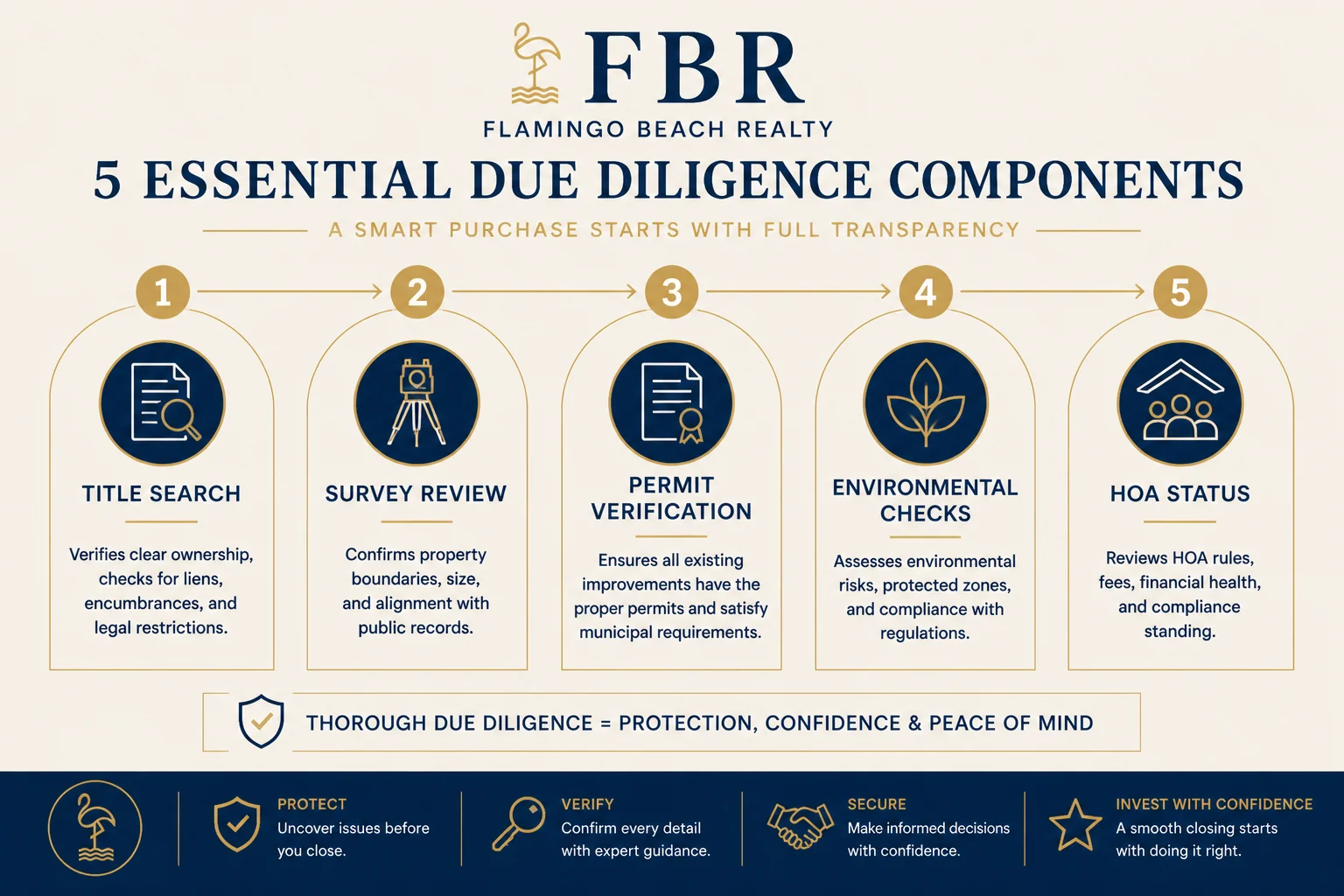
The due diligence period is negotiated in the Purchase & Sale Agreement (PSA) — typically 10–30 days, with the average being 21 calendar days from the accepted offer. During this period, your deposit is typically refundable if due diligence reveals a disqualifying issue. After the due diligence period closes, the deposit is generally non-refundable.
Note
Title insurance does not exist in Costa Rica. Unlike in the United States or Canada, there is no title insurance product available to buyers. Your independent attorney’s thorough title search is your only protection against title defects.
The scope of due diligence includes:
- Title search (National Registry): back 30+ years confirming ownership chain, liens, mortgages, annotations, and encumbrances.
- Cadastral survey review: confirming the registered plano catastrado (survey map) matches physical boundaries and that no encroachments, discrepancies, or disputed boundaries exist.
- Municipal permit verification: confirming all structures on the property have valid construction permits from the relevant municipality.
- Environmental restrictions: checking for SETENA (environmental agency) limitations, wetland buffer zones, protected area designations, or other restrictions on use or development.
- HOA and condominium status: confirming dues are current, no pending special assessments, and reviewing reserve fund health.
- Corporate status (if applicable): if taking title through a corporation, verifying the corporation is in good standing, tax current, and properly structured.
- Maritime Zone verification (beachfront): full concession status check if any portion of the property is within 200 meters of the high tide line.
Question 02
How do I choose the right attorney for due diligence?
Direct Answer
Your real estate agent will recommend you to a trusted attorney. Your attorney must be independent of your real estate agent. They should specialize in real estate transactions, be bilingual, have verifiable experience with foreign buyers, and practice primarily in the relevant municipality or region where the property is located.

What to look for
- Specialization in real estate: Costa Rica has general practitioners and specialists. For a $1M+ transaction, you want someone whose primary practice is real estate conveyancing — not someone who handles real estate occasionally alongside other practice areas.
- Regional experience: real estate law in Guanacaste involves municipal regulatory plans, local concession regimes, and relationships with the relevant registry offices. An attorney based in San José with limited Guanacaste experience is not the same as one who practices here regularly.
- Independence from your agent: your agent and your attorney should not work at the same company. They should be independent of each other.
- Bilingual capability: your attorney will be explaining complex legal concepts and reviewing documents with you. Full fluency in English is essential, not just functional.
- Transparent fee structure: attorney fees in Costa Rica are regulated by the Bar Association at 1.25–1.5% of the purchase price. Be cautious of attorneys who quote significantly below the regulated minimum.
FBR maintains a vetted referral network of independent attorneys across Guanacaste. We are transparent that these are referrals, not affiliated relationships — your attorney works for you, not for us.
Question 03
What are the most common title problems in Costa Rica?
Direct Answer
The most common title issues are unregistered encumbrances (liens or restrictions not properly annotated in the Registry), boundary discrepancies between the physical property and the registered plano, unpermitted structures, and — for beachfront properties — concession irregularities. None of these are dealbreakers by default, but all require resolution before closing.
Common issues and what they mean:
- Unpermitted structures: a significant percentage of improvements and additions in Costa Rica were built without municipal permits. Unpermitted structures carry risk: they can be subject to demolition orders and complicate resale. Your attorney must verify permits for every structure on the property, not just the main dwelling. In addition, building permits can occasionally no longer exist at the municipality due to natural disasters — this has occurred even in large developments such as Reserva Conchal, where many condos built in the early 2000s no longer have existing permits on file. When this happens, attorneys request a written letter from the municipality confirming that permits do not exist.
- Boundary discrepancies: the registered plano may not match the physical fencing or the seller’s representations about the property. This can involve encroachments onto neighboring land or loss of area. Requires a licensed topographer to re-survey and confirm.
- Liens and annotations: mortgages, judicial liens, pending legal actions, and certain contracts can be annotated in the National Registry. A thorough title search back 30+ years surfaces these. Some annotations are historical and resolved — others are active and block transfer.
- HOA arrears: unpaid HOA dues in gated communities can result in restrictions on the transfer of the property or demands for payment at closing. Your attorney requests the HOA status certificate as part of standard due diligence.
- Corporate irregularities: if the property is held in a corporation, the corporation must be in good standing, tax current, and properly structured. Corporations with delinquent filings or unpaid corporate tax create complications in the transfer.
Question 04
How long does due diligence take and what does it cost?
Direct Answer
A thorough due diligence review in Costa Rica takes 10–21 days under normal conditions. The cost is included in your attorney’s fee (1.25–1.5% of the purchase price), which covers the title search, document review, and closing preparation. Survey verification, environmental review, or complex concession analysis may involve additional specialist fees.
Timeline by component
- National Registry title search: 2–5 business days for standard properties. Complex titles or older registrations may take longer.
- Municipal permit verification: 3–7 business days depending on the municipality’s responsiveness and filing systems.
- HOA status certificate: typically 3–5 business days from the HOA administrator.
- Survey review: if a re-survey is needed, 5–14 days depending on topographer availability and property complexity.
- Environmental and regulatory checks: 3–10 business days depending on the agency and complexity of the restriction.
Additional costs to be aware of: if re-survey is required, topographer fees typically run $500–$1,500 depending on property size and complexity. Environmental permits, INDER verifications, or complex concession reviews may involve specialist fees negotiated directly with your attorney.
The cost of thorough due diligence is a fraction of 1% of the purchase price. The cost of closing on a property with undiscovered title problems can be the full purchase price plus legal fees. There is no defensible reason to abbreviate due diligence on a significant purchase.
Question 05
What are the red flags that should stop a transaction?
Direct Answer
Some issues discovered in due diligence are manageable — they require negotiation, price adjustment, or additional documentation but do not disqualify the purchase. Others are genuine dealbreakers. Knowing the difference protects you from both walking away from a fixable situation and closing on a broken one.
Issues that require negotiation but are often resolvable
- Minor unpermitted additions: a small storage room or deck added without permits is common and can often be regularized with the municipality post-closing, with the cost negotiated into the price.
- HOA arrears: typically negotiated to be settled by the seller at closing.
- Minor boundary discrepancies: small variances between the registered survey and physical boundaries can sometimes be resolved through a corrected survey and re-registry.
Issues that are likely dealbreakers or require extreme caution
- Active judicial liens or legal proceedings: a property with a court-ordered embargo or active litigation against the title is generally untransferrable until the matter is resolved.
- Significant unpermitted construction: a main dwelling built without permits carries demolition risk that cannot be fully mitigated post-closing.
- Expired or invalid concession (beachfront): a concession that has lapsed without renewal, or that was never legally granted, means there is no legal basis for the occupancy of the land.
- Non-compliant concession structure: if the concession entity exceeds the 49% foreign ownership limit without qualifying residency, the concession is in violation of the Maritime Zone Law — a structural problem that cannot be papered over.
- Unresolved boundary dispute with a neighbor: an active dispute over shared boundaries or encroachments typically cannot be closed around.
Your attorney will advise you on how to classify any issue discovered. Trust that advice. The value of an experienced, independent attorney is not in getting deals done — it is in protecting you from the deals you should not do.
About Flamingo Beach Realty
Flamingo Beach Realty is the #1 luxury real estate brokerage on Costa Rica’s Guanacaste Gold Coast, with 500+ five-star reviews and $900M+ in closed transactions. We serve buyers and sellers across Playa Flamingo, Reserva Conchal, Hacienda Pinilla, Las Catalinas, Peninsula Papagayo, and the surrounding Guanacaste communities.
Ready to buy with confidence in Costa Rica?
Talk directly with Melanie Engel, principal broker and founder of Flamingo Beach Realty — 500+ five-star reviews, $900M+ in closed transactions across Guanacaste’s Gold Coast.