
Buyer’s Guide · Guide #3 of 10
Fee-Simple vs. Concession Property: What Every Foreign Buyer Must Know
Most Guanacaste luxury properties are fee-simple with full private title. Concession applies only to beachfront land within 200 meters of the high tide line. Here is what foreign buyers must verify before making any offer — especially on beachfront property.

A Note from Melanie
I’ve been selling luxury real estate on Costa Rica’s Guanacaste Gold Coast for a decade. I’ve watched hundreds of foreign buyers navigate this market — some smoothly, some not. The questions in this guide are the ones I answer on almost every first call. My goal here is to give you exactly what I’d tell a close friend who called asking about buying in Costa Rica. No fluff. Just what you need to know.
Key Takeaways
- Most Guanacaste luxury properties are fee-simple: full private ownership registered with Costa Rica’s National Registry — equivalent to freehold title.
- Concession property applies only to land within 200 meters of the high tide line under the Maritime Zone Law (Ley 6043).
- The first 50 meters (Public Zone) cannot be privately owned by anyone — not even Costa Rican citizens.
- Foreign nationals cannot hold more than 49% of a concession-holding entity without 5+ years of legal Costa Rican residency.
- A concession is a government-granted license to use the land — not ownership. The land remains state property. How renewals work is covered in our guide to maritime zone concession renewal.
- Always verify title type with an independent attorney before making any offer, especially on any beachfront property.
Question 01
What is fee-simple property in Costa Rica?
Direct Answer
Fee-simple is full private ownership of land, registered with Costa Rica’s National Registry (Registro Público). It is functionally equivalent to freehold title in the US or Canada. The owner has the right to use, rent, sell, or transfer the property without government approval. The vast majority of Guanacaste’s luxury inventory is fee-simple.
Fee-simple title is identified by a folio real — a unique registration number in the National Registry. The title record shows ownership history, liens, mortgages, encumbrances, easements, and the property’s cadastral survey (plano catastrado). A title search back 30+ years is standard practice during due diligence.
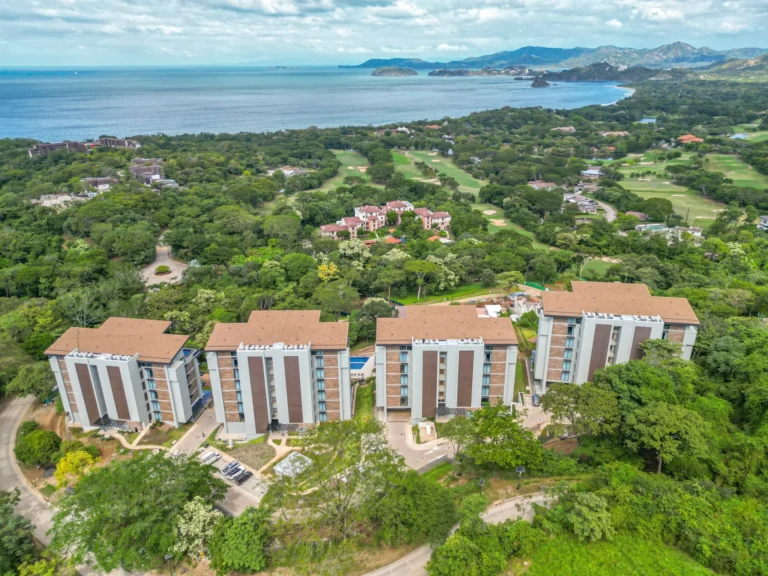
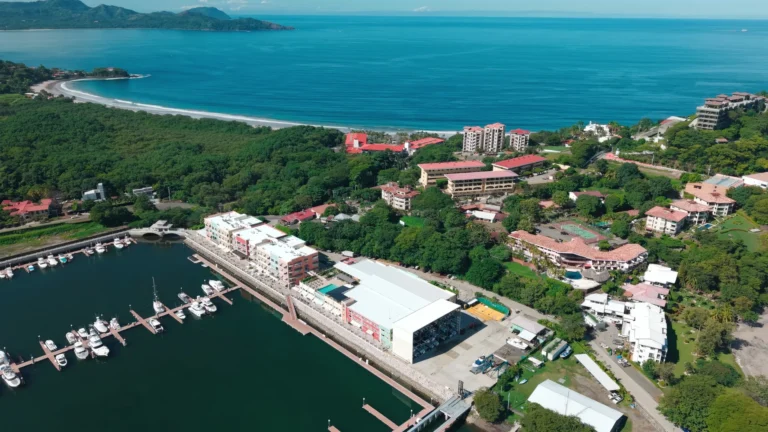
Properties in Reserva Conchal, Hacienda Pinilla, Las Catalinas, Peninsula Papagayo, and Playa Flamingo’s residential neighborhoods are almost all fee-simple. Condominiums in these communities are typically fee-simple units within a registered condominium regime governed by Costa Rica’s Condominium Law (Ley 7933).
Fee-simple is what you want. If the title is clean, the transaction structure is straightforward — your attorney conducts due diligence, you close via public deed before a Costa Rican Notary, and title transfers upon registration with the National Registry.
Question 02
What is concession property under Costa Rica’s Maritime Zone Law?
Direct Answer
Costa Rica’s Maritime Zone Law (Ley 6043) governs all land within 200 meters of the high tide line on both coasts. This zone is divided into two strips: the Public Zone (first 50 meters) and the Restricted Zone (50–200 meters). The Public Zone is entirely state-owned and cannot be privately occupied under any circumstances. The Restricted Zone may be subject to a concession — a government-granted license to use the land.
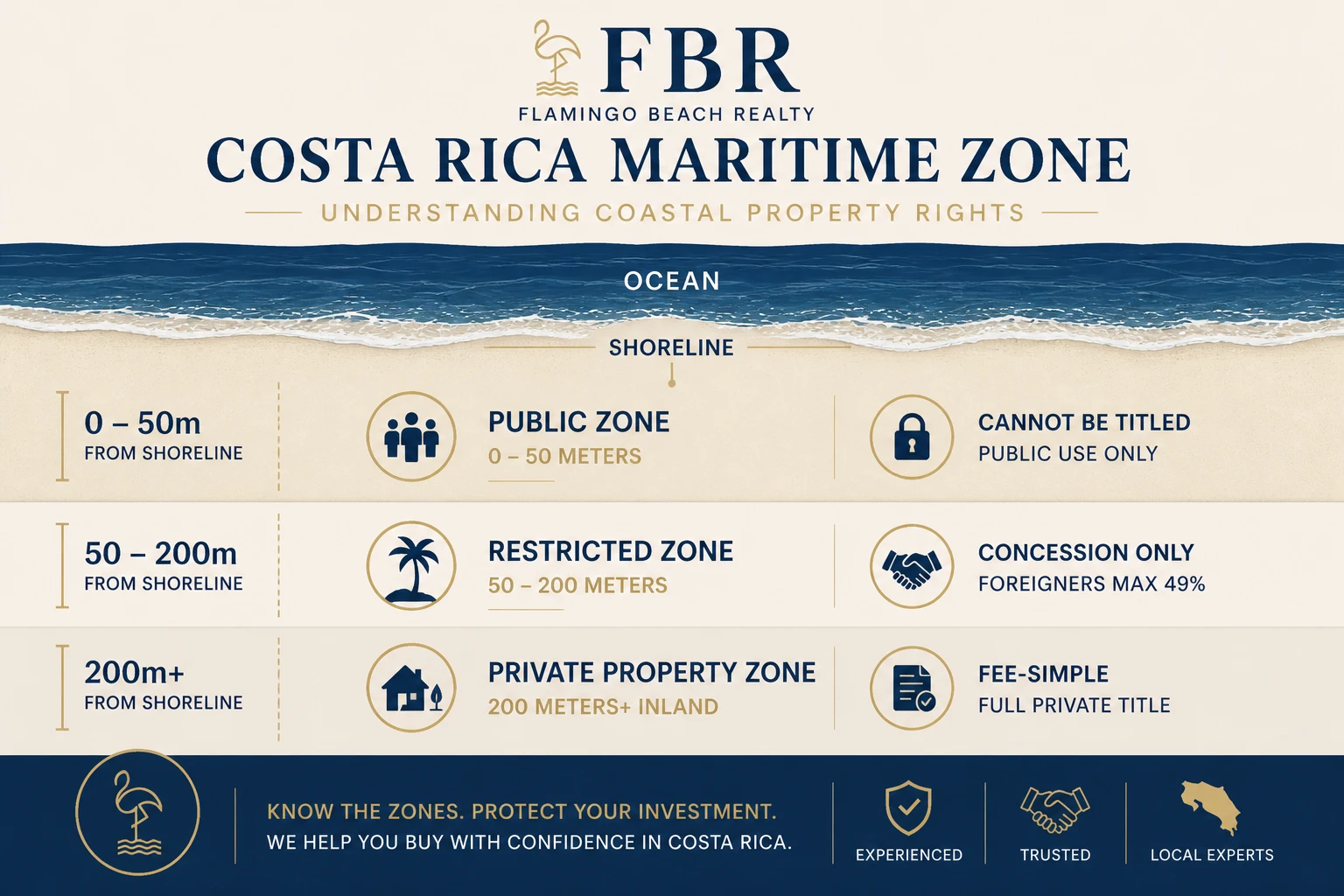
A concession is not ownership. The underlying land in the Restricted Zone belongs to the Costa Rican state. A concession holder has the right to use, develop, and occupy the land under terms defined by the relevant municipality and INDER (Instituto de Desarrollo Rural). Concessions are typically granted for 20-year periods and are renewable.
Critically: concession rights can be revoked. Failure to pay annual concession fees, unauthorized construction, abandonment, or violation of the terms of the concession can result in the concession being cancelled by the municipality — without compensation to the holder.
The Maritime Zone is measured from the high tide line — not the property boundary, not the road, not the first building. This is determined by official survey. Properties that appear to be well inland of the beach may still fall within the Restricted Zone depending on how the coastline is measured at that location.
The two zones in detail
Public Zone (first 50 meters from high tide line): state-owned and non-negotiable. No private occupation, construction, or title of any kind is permitted. This strip belongs to all Costa Ricans.
Restricted Zone (50–200 meters from high tide line): may be subject to a concession granted by the relevant municipality. Not all land in the Restricted Zone has an active concession — some is vacant public land. Not all municipalities have approved regulatory plans, which affects whether concessions can be granted at all.
Question 03
Can foreigners buy concession property?
Direct Answer
Yes, with significant restrictions. Foreign nationals cannot hold more than 49% of the entity holding a concession unless they have 5 or more years of legal residency in Costa Rica. This applies only to concession property — foreigners have exactly the same constitutional property rights as Costa Ricans on all fee-simple land.
In practice, most concession properties near the beach are held through Costa Rican corporations (S.A. or S.R.L.) structured to comply with the 49% ownership rule. A foreign buyer may hold up to 49% of the corporation. The remaining 51% must be held by Costa Rican nationals or individuals with 5+ years of documented legal residency.
This structure carries real risk that fee-simple ownership does not. Your interest in the corporation is not the same as owning the underlying land. The quality, trustworthiness, and legal structure of the Costa Rican shareholders matter significantly. Your attorney’s role in structuring and documenting the corporate agreement is not a formality — it is the foundation of your protection.
Important context for buyers: the 49% restriction applies only to concession land. If a property is fee-simple — even if it is 201 meters from the high tide line and has an ocean view — a foreign buyer can own it outright, 100%, the same as any Costa Rican. The restriction is specifically and exclusively about the Maritime Zone concession regime.
Question 04
How do I verify whether a property is fee-simple or concession?
Direct Answer
Your independent Costa Rican attorney conducts a title search at the National Registry (Registro Público) as part of due diligence. This process verifies title type, confirms boundaries, and identifies any Maritime Zone restrictions. It is non-negotiable and costs a fraction of the purchase price.
The verification process includes:
- National Registry title search: confirms whether the property has a registered folio real. If it does, it is fee-simple. If no folio real exists, the property may be concession or unregistered public land.
- Cadastral survey review: the official plano catastrado shows property boundaries and their relationship to the high tide line. Any property within 200 meters requires careful boundary analysis.
- INDER and municipal records: if concession is involved, your attorney checks registration status, current fee payments, and any pending administrative actions.
- Regulatory Plan check: the municipality’s Plan Regulador determines whether concessions can be granted or renewed in that area. Municipalities without approved Plans cannot legally grant new concessions.
Never rely solely on the seller’s representation that a property is fee-simple. This verification takes a few days and costs well under 1% of the purchase price. There is no justification for skipping it.
Question 05
What specific due diligence is required for concession properties?
Direct Answer
Concession due diligence is significantly more complex than fee-simple and requires several verifications beyond a standard title search. Your attorney must confirm active concession status, ownership compliance, construction permits, regulatory plan status, and environmental restrictions — all before you remove contingencies.
For any concession property, your attorney must verify:
- Concession status: is the concession active and current, or expired and in arrears? An inactive concession has no legal protection.
- Annual fee payment: all annual concession fees to the municipality must be current. Arrears can jeopardize renewal and in some cases trigger revocation.
- Concession term and renewal history: when does it expire? What is the track record of renewals? Is there any administrative dispute about the renewal?
- Regulatory Plan (Plan Regulador): does the municipality have an approved regulatory plan? If not, the concession may not be legally renewable. This is a critical point — not all municipalities have approved Plans.
- Foreign ownership compliance: what percentage of the concession-holding entity is currently held by foreign nationals? Is the structure compliant with the 49% limit? Has this been formally documented?
- Construction permits: have all structures on the concession been permitted by the municipality? Unpermitted structures on concession land can face demolition orders — and the municipality has enforcement authority.
- INDER registration: is the concession properly registered with INDER and in good standing with that agency?
- Environmental restrictions: is any part of the property subject to SETENA (environmental permitting) review, wetland protection designations, buffer zones, or protected area restrictions?
One additional note: title insurance, while available in Costa Rica, is not standard practice the way it is in the US. For concession properties especially, thorough attorney-led due diligence is your primary protection. Do not substitute title insurance for the verification steps above.
About Flamingo Beach Realty
Flamingo Beach Realty is the #1 luxury real estate brokerage on Costa Rica’s Guanacaste Gold Coast, with 500+ five-star reviews and $900M+ in closed transactions. We serve buyers and sellers across Playa Flamingo, Reserva Conchal, Hacienda Pinilla, Las Catalinas, Peninsula Papagayo, and the surrounding Guanacaste communities.
Ready to buy with confidence in Costa Rica?
Talk directly with Melanie Engel, principal broker and founder of Flamingo Beach Realty — 500+ five-star reviews, $900M+ in closed transactions across Guanacaste’s Gold Coast.