
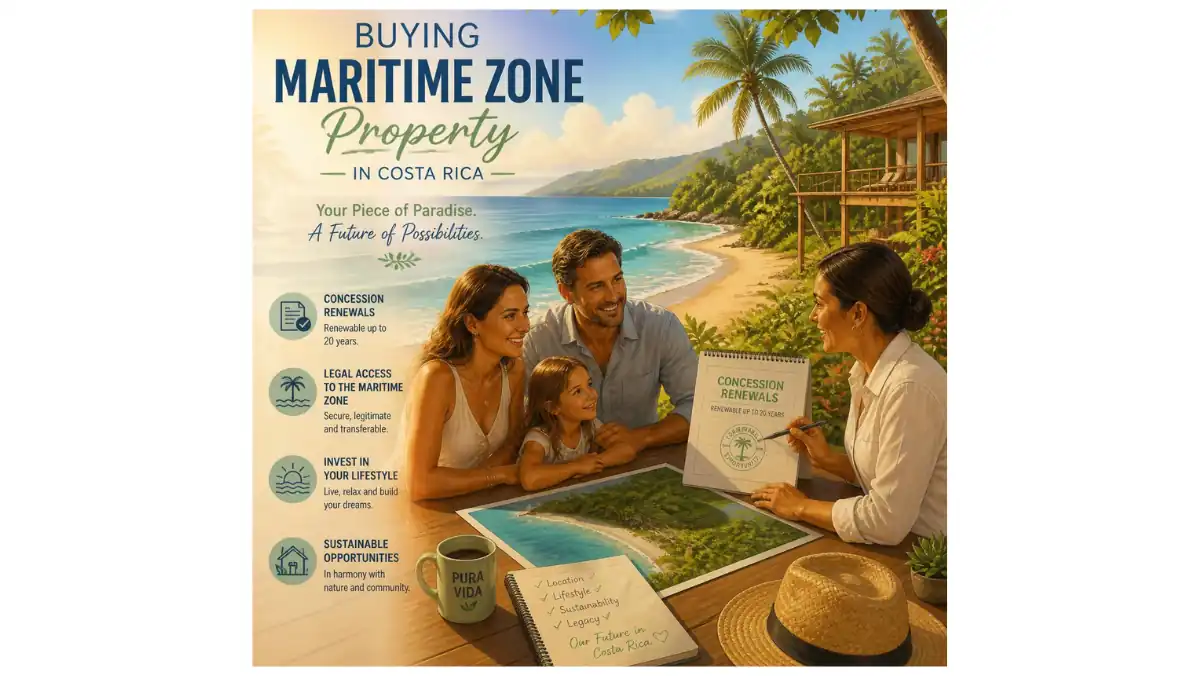
Anyone who owns or is considering buying property inside Costa Rica’s Maritime Zone eventually runs into the same question: what actually happens when the concession comes up for renewal? Unlike titled property, where ownership is permanent once the deed is registered, a maritime zone concession is a time-limited right of use granted by the state. Understanding how renewal works — and what can put it at risk — is essential for anyone whose home, hotel, or business sits inside this coastal strip.
What the Maritime Zone actually is
Costa Rica’s Zona Marítimo Terrestre, or ZMT, is regulated under Law 6043 and covers the first 200 meters of land measured from the average high-tide line along the entire coastline. This band is split into two parts. The first 50 meters, closest to the water, is the public zone. It belongs to the state, cannot be built on, and must remain open for everyone to use. The remaining 150 meters is the restricted zone, and this is where concessions become possible. Land here cannot be privately titled, but individuals, corporations, and developers can obtain the right to use and build on it through a government-issued concession.
A concession is best understood as a long-term lease rather than ownership. The state retains the underlying land, and the concessionaire pays an annual fee to the municipality in place of traditional property tax. Terms are commonly granted in blocks that run up to 20 years, though the exact length can vary by municipality and by the terms of the local regulatory plan governing that stretch of coast.
Who is eligible to hold and renew a concession
Not everyone can walk in and apply. Foreign individuals are generally required to have several years of legal residency in Costa Rica before they can hold a concession directly in their own name, and Article 47 of Law 6043 sets specific limits on foreign participation. Where a corporation holds the concession instead, Costa Rican nationals typically need to control a defined percentage of the company’s shares. These same eligibility rules apply again at renewal time, so a change in a company’s ownership structure or a lapse in a foreign holder’s residency status can complicate the process even for a concession that has otherwise been well maintained.
The core steps in the renewal process
While the exact procedure can differ slightly from one municipality to the next, the renewal process generally follows a consistent sequence.
- Review of compliance history. Before anything is submitted, the municipality checks whether the concessionaire has paid all annual fees on time, followed the terms of the original concession contract, and stayed within the building and use restrictions set out when the concession was first granted. Unpaid fees or unauthorized construction are among the most common reasons a renewal request runs into trouble.
- Confirmation against the municipal regulatory plan. Every concession must conform to the local “plan regulador,” the zoning plan that dictates how coastal land in that jurisdiction can be used. If the plan has changed since the concession was issued, or if the property’s use no longer matches current zoning, the renewal may require adjustments to the project or additional permitting.
- Environmental and land-use verification. Municipalities typically confirm that the property remains free of encroachment into the public zone, that any required environmental protections are intact, and that the concession still serves the purpose originally approved, whether that is residential use, tourism, or commercial development.
- Application submission to the municipality. The concessionaire, or their legal representative, files a formal renewal request with the local municipal council, which administers concessions at the local level.
- National-level ratification through ICT. In areas designated as tourist zones, municipal approval alone is not enough. The Instituto Costarricense de Turismo must also ratify the renewal, adding a second layer of review before the extension becomes final.
- Updated registration. Once approved, the renewed concession is recorded, and the concessionaire receives updated documentation reflecting the new term and any modified conditions.
Renewal is common, but never automatic
A point worth repeating for anyone relying on a maritime zone property as a long-term investment: renewal is not a legal guarantee. Concessions that are in good standing, with fees paid and terms respected, are renewed as a matter of routine practice in most municipalities. But the law does not grant an automatic right to renewal the way titled property confers permanent ownership. Municipal councils retain discretion, and a change in local zoning priorities, environmental designations, or municipal leadership can, in rare cases, affect the outcome even for a compliant concessionaire.
This is one of the central differences between concession land and fee-simple title, and it is why buyers are consistently advised to treat maritime zone property as a long-term leasehold rather than as equivalent to outright ownership.
Practical steps for concession holders
For anyone approaching a renewal date, a few habits make the process considerably smoother. Keep annual fee payments current and keep receipts organized, since payment history is the first thing municipalities check. Confirm early whether the local regulatory plan has changed since the concession was issued, as this can require lead time to address. Foreign holders should track residency requirements well before the renewal window opens, since a gap in status can delay approval. Corporations should periodically confirm their Costa Rican ownership percentage still meets the legal threshold. And because renewal touches both municipal and national authorities, working with a Costa Rican attorney who specializes in maritime zone law is standard practice, particularly for commercial or tourism-related concessions where the stakes of a denied renewal are highest.
The bottom line
The Maritime Zone concession renewal process in Costa Rica is manageable and, for compliant holders, generally successful — but it is not a formality. It requires municipal review, adherence to the local zoning plan, and in tourist areas, sign-off from the national tourism institute. Treating compliance as an ongoing responsibility rather than a box to check only near the renewal date is the most reliable way to protect a property’s long-term value on Costa Rica’s coastline.
At Flamingo Beach Realty, we understand that purchasing concession property requires a different level of due diligence than purchasing traditionally titled real estate. When our clients are considering property within Costa Rica’s Maritime Zone, we work alongside experienced Costa Rican attorneys and other qualified professionals who understand concession rights, municipal requirements, regulatory plans, renewal considerations, and the additional issues that need to be reviewed before a buyer moves forward.
A beautiful beachfront location can be an incredible investment, but with concession property, understanding exactly what you are buying is just as important as the property itself. The right professional team can help you evaluate the concession, identify potential risks, and make an informed decision before you commit.
Considering buying beachfront or concession property in Costa Rica? Contact Flamingo Beach Realty. We’ll help you find the right property and connect you with experienced professionals who can guide you through the additional due diligence required for Maritime Zone real estate.